
Overview
Research Interests
Enteroendocrine Cell Biology
Enteroendocrine cells (EECs) are sensory cells of the gut that send signals throughout the body. They have the ability to sense food and nutrients in the lumen of the intestine and secrete hormones into the blood. Our laboratory has had a longstanding interest in two types of EECs that regulate satiety and signal the brain to stop eating. Cholecystokinin (CCK) is secreted from EECs of the upper small intestine and regulates the ingestion and digestion of food through effects on the stomach, gallbladder, pancreas and brain. Peptide YY (PYY) is secreted from EECs of the small intestine and colon and regulates satiety. We recently demonstrated that CCK and PYY cells not only secrete hormones but are directly connected to nerves through unique cellular processes called ‘neuropods’. Our laboratory has conducted pioneering studies to characterize the structure and function of neuropods and have proposed novel and creative studies that will characterize a new concept for how enteroendocrine cells communicate with the nervous system. This newly discovered neural circuit is a point of communication between food and bacteria in the gut and the nervous system and has been referred to as the first step in the gut connectome. Our laboratory is devoted to understanding EECs signaling and its role in disease.
Pancreatitis
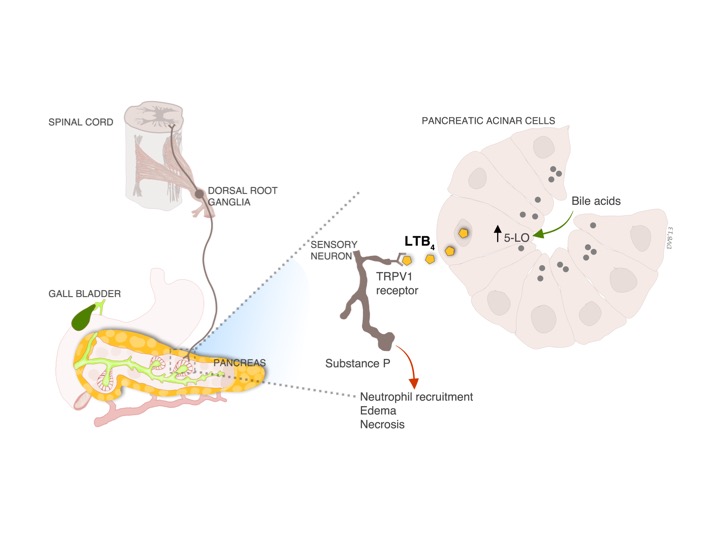
Pancreatitis is an inflammatory disease of the pancreas compounded by intrapancreatic activation of digestive enzymes. Our laboratory is studying the mechanisms involved in the development of pancreatitis. These studies have defined the importance of endogenous pancreatic secretory trypsin inhibitor PSTI (also known as serine protease Kazal type – SPINK) in the generation and prevention of pancreatitis. We have also described the importance of neurogenic inflammation in the initiation of pancreatitis. We have demonstrated that primary sensory neurons play a key role in acute pancreatitis and that the cation channel TRPV1 is a key mediator of pancreatic inflammation resulting from most causes clinical pancreatitis including alcohol and gallstone pancreatitis. We have identified the endogenous activator of TRPV1 and have evidence these mechanisms are relevant to human pancreatitis. Recently, we identified a mechanically activated ion channel Piezo1 in the pancreas that mediates pressure-induced pancreatic injury. We believe this is the mechanism for trauma, surgery, ERCP, and gallstone induced pancreatitis. Our goal is to identify novel targets for treating acute pancreatitis.
Pancreatitis and Pancreatic Cancer
Two major diseases of the pancreas are pancreatitis and pancreatic cancer. Pancreatitis is an inflammatory disease of the pancreas compounded by intrapancreatic activation of digestive enzymes. Our laboratory is studying the mechanisms involved in the development of pancreatitis. These studies have defined the importance of endogenous pancreatic secretory trypsin inhibitor PSTI (also known as serine protease Kazal type – SPINK) in the generation and prevention of pancreatitis. We have also described the importance of neurogenic inflammation in the initiation of pancreatitis. We have demonstrated that primary sensory neurons play a key role in acute pancreatitis and that the cation channel TRPV1 is a key mediator of pancreatic inflammation resulting from most causes clinical pancreatitis including alcohol and gallstone pancreatitis. We have identified the endogenous activator of TRPV1 and have evidence these mechanisms are relevant to human pancreatitis. Recently, we identified a mechanically activated ion channel Piezo1 in the pancreas that mediates pressure-induced pancreatic injury. We believe this is the mechanism for trauma, surgery, ERCP, and gallstone induced pancreatitis. We also identified Piezo1 in pancreatic stellate cells where it is linked to fibrosis and conversion of stellate cells to cancer associated fibroblasts. Blocking Piezo1 and downstream signaling reduces cancer growth and metastasis. These approaches unveil novel insights into the pathogenesis of pancreatitis and pancreatic cancer.
Grants
“Mechanisms of mechanically-induced acute pancreatitis” - NIH
“Mechanisms of Pancreatic Fibrosis”
“Phosphate in Human Acute Pancreatitis”
“The Gut-Brain Parkinson’s Disease Consortium”
“Mechanosensing in Pancreatic Cancer and Metastasis”
Lab Members
Rodger Liddle, MD
Primary Investigator
Joelle Romac, PhD
Senior Research Scientist
Sandip Swain, PhD
Assistant Professor in Medicine
Emily Koch
Student
Former Lab Members
Christi Ballard
Bryant Beebe
Bandana Bindhani, PhD
Diego Bohorquez, PhD
Ernest Bouras, MD
Jacqueline Carter
Rashmi Chandra, PhD
Katherine Chavez
Eunae Cho, MD
Carol Conrad
Supriya Davis
Alan Erdmann, MD
Ahmad Farooq, MD
Brian Fee, PhD
Tom Geracioti, MD
Barry Gooch, PhD
Senthil Gounder, PhD
Jasmine Hayes
Fariha Haque
Mash Haque
Liliana Hernandez, PhD
Yoshifumi Higashimoto, MD, PhD
Laine Hurst
John Humphrey, MD
Shuji Kanayama, MD, PhD
Stephanie King, MS
Subhag Kotrannavar
Alex Kreger
Beilei Lei, PhD
Seok Ting Lim, PhD
M. F. Majeed
Husam Mikati
Nidula Mullappilly, PhD
Jaimie Nathan, MD
Ibtehaj Naqvi, MD, PhD
Marc Noble, MD
Akash Patel, MD
Michael Peyton, PhD
Courtney Richman, MD
Grecia Rivera
Robert Rushakoff, MD
Lee Ann Samsa
Lee Ann Scott
Rafiq Shahid, MD
Ala Sharara, MD
Nicholas Snow, MD
Randy Taplitz, MD
Anthony Therattil
Steven R. Vigna, PhD
Yu Wang, PhD
Ian Williamson, PhD
Lihua Ye, PhD
Paul Yudelman, MD