
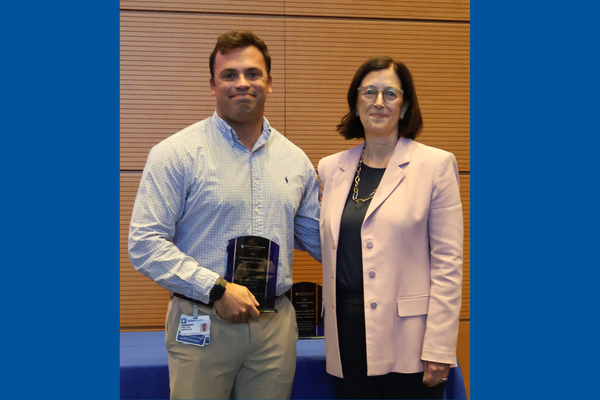
Preston Anderson receives award from Chair Dr. Kathleen Cooney
Preston Anderson, a student in the Duke Medical Scientist Training Program, has received the Duke Department of Medicine’s 2026 Distinguished Research Publication Award for research that offers new insight into how G protein-coupled receptors, or GPCRs, regulate cellular signaling.
The award recognizes publications with significant potential to positively affect human health through rigorous investigation of important biomedical problems. Anderson was recognized for the study, “β-Arrestin condensates regulate G-protein-coupled receptor function,” published in Nature in May.
Anderson co-led the research with Peng Xiao and Ya-Ni Zhong, working with senior investigators including Sudarshan Rajagopal of the Duke Department of Medicine. The study examined GPCRs, the largest family of cell-surface receptors in the human genome and targets for roughly one-third of FDA-approved therapeutics.
Researchers found that proteins known as β-arrestins can form dynamic structures called biomolecular condensates that help regulate GPCR function. Using super-resolution imaging and other approaches, the team showed that the formation and organization of these condensates influence how receptors are internalized and how signals are transmitted within cells.
The findings offer a new model for understanding GPCR signaling and could provide another avenue for drug development. Rather than targeting only the receptors themselves, future therapeutic approaches could potentially modify β-arrestin condensates to influence cellular signaling. The researchers noted potential relevance for diseases including heart failure, asthma, hypertension, metabolic disorders and neurologic disease.
The research was supported in part by an American Heart Association predoctoral fellowship awarded to Anderson, the Duke Medical Scientist Training Program and funding from the National Institutes of Health and other organizations.