
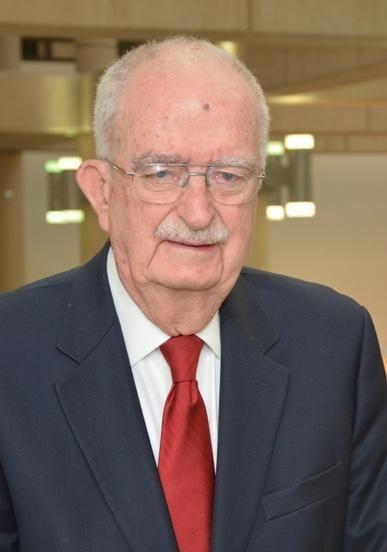
It is with great sadness that we share the passing of Wendell F. Rosse, MD, Florence McAlister Professor of Medicine Emeritus, a distinguished physician-scientist, educator and leader whose contributions left an enduring mark on Duke and the field of hematology.
Dr. Rosse’s connection to Duke began early in his medical career. From 1958 to 1960, he completed his internship and junior assistant residency in medicine at Duke. After conducting research at the National Institutes of Health and completing a visiting research fellowship in hematology in London, he returned to Duke in 1966 as an assistant professor of medicine.
Over the course of his distinguished career, Dr. Rosse’s work bridged disciplines across the School of Medicine. He held faculty appointments in medicine and immunology and was named Florence McAlister Professor of Medicine in 1981. He served as chief of the Duke Division of Hematology/Oncology from 1976 to 1984 and co-director from 1984 to 1989. He also served as director of the Duke Comprehensive Sickle Cell Center and, later, as associate dean for clinical education.
Dr. Rosse made important contributions to the understanding of complement and complement-related diseases, including paroxysmal nocturnal hemoglobinuria. He was a Howard Hughes Medical Institute investigator, served as president of the American Society of Hematology and was an associate editor of Blood. His accomplishments were recognized with numerous honors for research, teaching and service.
One of Dr. Rosse’s most enduring contributions was his commitment to developing future generations of physician-scientists. In 1975, he established Duke’s T32 Training Program in Hematology and Transfusion Medicine. More than five decades later, the program remains Duke’s longest continuously funded T32 training program and has prepared generations of investigators and leaders in hematology.
Dr. Rosse’s legacy is reflected not only in his scientific contributions, but also in the people, programs and areas of research he helped shape. His commitment to discovery, mentorship, education, academic medicine and excellence in patient care continues to influence Duke today.
We extend our deepest condolences to Dr. Rosse’s family, friends, colleagues, former trainees and all whose lives and careers he touched. We are grateful for his extraordinary service to Duke and for the lasting impact of his life and work.