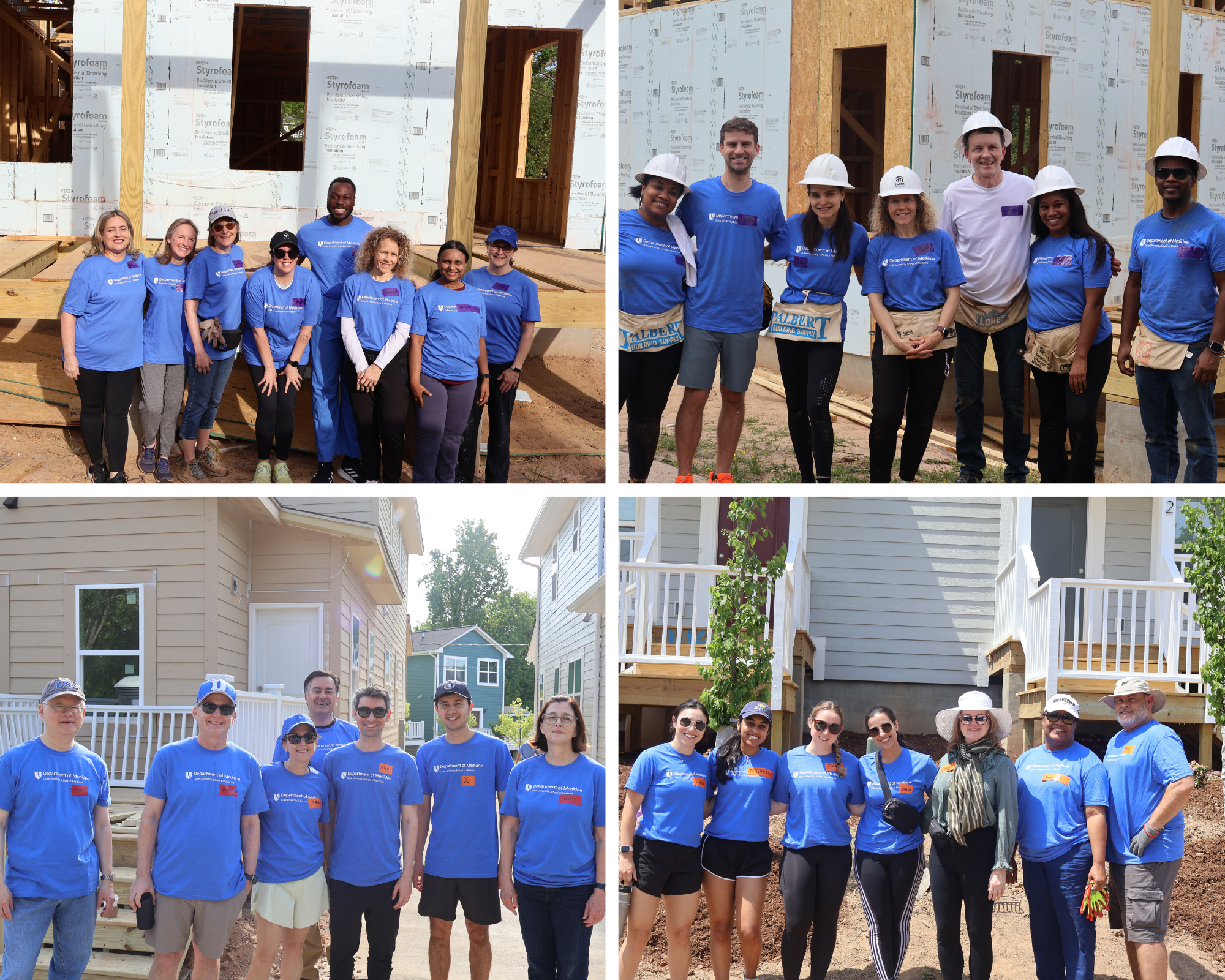
On a warm April morning in Durham, a group of volunteers gathered at a construction site, lacing up boots and pulling on gloves. By the end of the day, they would help raise the walls of a home. But the real structure taking shape wasn’t just wood and nails — it was something less visible and arguably more enduring: community.
For the Duke University Department of Medicine team, the project began as a team-building effort for faculty, staff, and residents. What it became was something deeper.
“We’re strengthening our community by partnering with Habitat for Humanity of Durham to meet the needs of the very community we serve as physicians and researchers,” said Department of Medicine Chair Dr. Kathleen Cooney. “Through service like this, our teams extend their impact beyond the clinic — complementing their clinical care and training in meaningful, tangible ways.”
The idea was simple — bring people together to serve a need — but the impact is far-reaching.
Bringing People Together
That need is urgent. In Durham, like much of the Triangle, the cost of housing continues to rise, putting homeownership out of reach for many working families. Habitat for Humanity of Durham steps into that gap, creating opportunities for affordable housing while requiring homebuyers to invest their own time and effort — known as “sweat equity” — into the process.
"Habitat for Humanity is doing very thoughtful work for our neighbors in Durham," said second-year Internal Medicine resident Victor Ayeni, MD. “It was both very meaningful and very fun to partner with them alongside my colleagues at Duke, from fellow residents to administrative staff to faculty. As housing insecurity continues to be a pressing issue in Durham, I hope this partnership between Habitat and the Department of Medicine continues, along with the enhanced Duke team culture that this event has already started to build.”
“Our volunteers are our bread and butter,” said Kirsten Ford, volunteer engagement supervisor for the Durham Habitat for Humanity affiliate chapter. “We have a construction team of about three to four people. Everything else depends on volunteers — corporate teams, students, community members — coming together to make these homes possible.”
When Duke’s Department of Medicine reached out, the response was immediate and enthusiastic. What started as a plan for a single group evolved into a coordinated, multi-day effort. Because of site limitations, the volunteers were split into smaller crews — 10 in the morning and 10 in the afternoon — across two build days in April for a total of around 40 participants.
The structure may have been logistical, but the outcome was deeply human.
Deeply Human Outcomes
During the April 25 build, a prospective home buyer joined the Medicine team to complete his sweat equity. The buyer came to America from Ecuador, and first applied to Habitat for Humanity of Durham in January 2024 with the goal to become a first-time home buyer. He credits Habitat for Humanity as a great opportunity and is excited for his family’s new journey as homeowners.
Anna Baker, Gastroenterology and Advanced Endoscopy Fellowship coordinator, chose to volunteer because of a meaningful experience she had in high school helping build homes for families in Mexico.
“That experience was truly life-changing and left a lasting impression on me,” she said. “When I saw the opportunity to participate in the Department of Medicine Habitat for Humanity build, I knew I wanted to be involved. It was both incredibly rewarding and physically demanding, but I had such a great time working alongside others for a shared purpose.”
“They exceeded our expectations,” Ford said. “They came ready to work. They were excited. They didn’t just show up—they engaged. It was hot, it was physical — but they jumped right in. They were an A+ group.”
On one of the build days, volunteers had the rare opportunity to raise a wall on the second floor of a home — an experience not every group gets. Under the guidance of site supervisors, they measured, lifted, and secured the frame together, watching in real time as their collective effort transformed into something tangible.
Setting Up for Success
Beyond the build site, the team extended its impact through fundraising, organizing a peer-to-peer campaign with a goal of $10,000 to support construction costs. Nearly reaching that mark, the effort underscored another reality of affordable housing: it requires not just labor, but resources.
“Materials are expensive. Land is expensive. Everything is,” Ford added. “Even though we have land, we need funding to build on it.”
Habitat’s model is intentionally measured. The Durham affiliate builds about six to seven homes per year, carefully selecting 10 to 15 homebuyers who meet income qualifications and are prepared for the financial responsibilities of ownership. The goal isn’t just to build houses—it’s to ensure long-term stability for the families who will live in them.
“We want to set people up for success,” Ford explained. “This is about more than getting someone into a home. It’s about keeping them there.”
For volunteers, that perspective often reframes the experience. Tasks that might seem small—hammering nails, framing walls—take on new meaning when tied to a family’s future.
“Even if you’re just doing one piece of the work, it matters,” Ford said. “That’s going toward someone’s home.”
For her, the mission is personal. A Durham native and self-described “nonprofit girly,” Kirsten traces her passion for community work back to her time in AmeriCorps. Today, she channels that passion into connecting people with purpose.
“People need food, clothing, and shelter,” she said. “If I can be part of helping meet those needs — and help others do the same — that’s everything.”
That sense of shared responsibility is what made the Duke team’s involvement so powerful. What began as a workplace activity became a reminder that teams function best not just when they work together, but when they work toward something bigger than themselves.
In the end, the walls they raised will shelter a family. But the experience itself built something just as important: a stronger, more connected community — one volunteer, one team, one home at a time.
Click image below to view full photo album.