
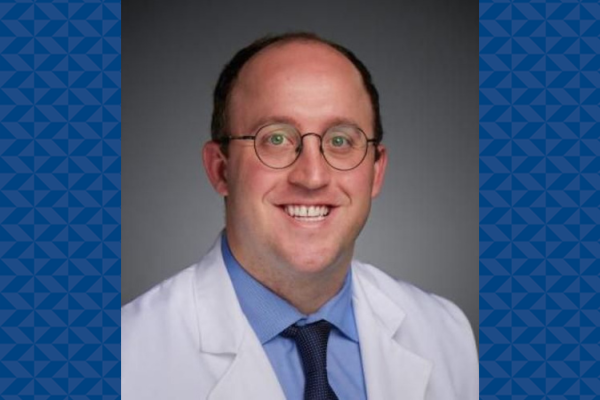
Duke physician-scientist Benjamin Catanese, MD, is taking on a critical gap in modern medicine: how to safely extend the benefits of popular weight-loss drugs to patients with chronic kidney disease.
Dr. Catanese, a medical instructor in the Division of Nephrology, has been named to the 2026 cohort of the Duke Clinical and Translational Science Institute K12 Scholars program that supports early-career investigators working to accelerate the translation of scientific discoveries into better patient care.
His research focuses on improving treatment for patients living with obesity, diabetes, and chronic kidney disease (CKD)—conditions that frequently overlap but are often studied in isolation. His work aims to ensure that rapidly advancing therapies are safe and effective for populations historically underrepresented in clinical trials.
The Key Question
At the center of his K12 project is a pressing clinical question: how glucagon-like peptide-1 (GLP-1) receptor agonists — widely prescribed medications for diabetes and weight loss — affect patients with advanced kidney disease.
An estimated 37 million U.S. adults live with CKD, and roughly half also have obesity. Meanwhile, GLP-1 receptor agonists are being used by millions nationwide. Despite their growing popularity, patients with more advanced kidney disease were largely excluded from major clinical trials, leaving physicians with limited evidence to guide treatment decisions.
“GLP-1 receptor agonists are highly effective for weight management,” Catanese said. “But patients with chronic kidney disease were largely excluded from the major obesity trials, so we don’t fully understand how they respond — or how to optimize treatment for them.”
Under the mentorship of Christina Wyatt, MD, Catanese will study how these medications influence body composition, metabolism, and physical function in patients with CKD. A key focus will be understanding muscle loss, a potential risk in this vulnerable population that could offset some of the benefits of weight reduction.
“If we can understand how much muscle patients may lose and what that means for their function, we can design strategies to maximize the benefits of these medications while minimizing potential harms,” he said.
More Personalized Approach to Obesity Care
The study will combine advanced body composition analysis with metabolomic profiling to better understand how individuals respond to treatment. The goal is to identify which patients are most likely to benefit — and which may face higher risks — laying the groundwork for more personalized approaches to obesity care.
Catanese’s interest in the research is rooted in his clinical experience.
“I’ve seen patients start these promising medications and not benefit — or even have to stop them,” he said. “It’s not that they can’t benefit. It’s that we need to better understand how to use these therapies for them.”
The implications of the work extend beyond kidney disease. Similar evidence gaps exist for other medically complex populations, including older adults and patients with cancer, who are also frequently excluded from clinical trials.
The K12 award, funded by the National Institutes of Health, provides three years of support, including 75% protected research time, funding for research expenses, and travel support—totaling approximately $376,500 per scholar.
By investing in early-career investigators like Catanese, the program aims to strengthen the pipeline of translational scientists and accelerate the delivery of patient-centered innovations to the clinic.
As new therapies reshape the landscape of obesity and metabolic disease, Catanese’s work seeks to ensure that no patient population is left behind.