
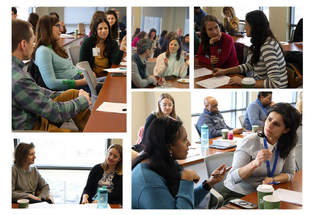
The Department of Medicine’s Faculty Career Development Program (FCDP) hosted its second annual professional development workshop on Wednesday, Feb. 25, drawing a record number of participants among faculty seeking structured career support.
Held at Erwin Square, the half-day event welcomed over 37 faculty members.
“This is only the second year we’ve used the workshop format,” said Dr. Carla Brady, Medicine vice chair for Faculty Development. “Seeing the room filled with participants reflects both increased interest and the need for this kind of focused professional development.”
A Program Reimagined
The workshop also marked an important transition for the initiative, formerly known as the Faculty Development Academy. The program was renamed the Faculty Career Development Program to more clearly reflect its emphasis on longitudinal career growth, mentorship, and advancement strategies for faculty across career stages.
“The new name makes our purpose explicit,” Dr. Brady added. “We want faculty to immediately understand that this program is about supporting their career trajectory—whether that’s in clinical innovation, education, research, or leadership.”
While the program retains its branch-based organizational structure — designed to address different faculty career pathways — those branches have been refined and renamed to better communicate their goals and areas of focus. Each branch provides tailored opportunities that align with varied faculty needs, allowing participants to engage in ways most relevant to their professional interests.
Structured development and mentorship are vital for sustaining excellence in academic medicine. This program provides an essential framework for our faculty to strengthen skills in communication, professional growth, and strategic thinking—tools that are critical not only for individual advancement but also for fostering healthy, high‑performing teams.
Dr. Sangeeta Joshi, a professor in the Division of Pulmonary, Allergy, and Critical Care Medicine, is this year assuming a FCDP leadership role as chair of the Faculty Advancement for Clinician Educators branch, where she is cultivating an environment where faculty feel supported, connected, and empowered-experiences she valued as past participant.
“The program creates an intentional space for reflection, skill‑building, and community,” she said. “It encourages us to think more broadly about our impact and helps faculty navigate their careers with greater clarity and purpose. In many ways, that’s why it matters so much — and why colleagues should consider participating.”
From Two Years to One: A Strategic Shift
One of the most significant changes to the FCDP is its transition from a two-year curriculum to a one-year calendar cycle. Leaders say the adjustment was made in response to faculty feedback and the realities of academic scheduling.
Moving to a calendar-year model avoids competing with the busiest parts of the academic cycle, which made participation difficult to prioritize. By launching the program after the academic year is already underway, faculty can engage more thoughtfully and consistently, without the competing demands that accompany the start of a new academic year.
Each year, a new cohort is selected to participate in the streamlined, year-long experience that emphasizes practical skill-building, individualized coaching, and peer collaboration.
Coaching and Community at the Core
A hallmark of the FCDP remains its emphasis on mentorship and coaching. Experienced faculty serve as coaches within each branch, offering guidance on goal-setting, leadership development, scholarly productivity, and navigating academic medicine.
Several long-standing coaches continue to play central roles in the program, providing continuity and institutional knowledge. At the same time, leadership opportunities within branches allow experienced participants to take on new responsibilities, fostering a culture of shared learning and professional stewardship.