
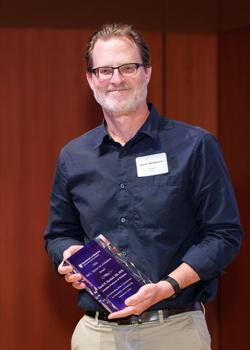
When the Neil L. Spector Art of Medicine Award was established in memory of a physician known for pairing scientific rigor with deep humanity, its purpose was clear: to recognize those who elevate not just research, but the people behind it.
This year’s recipient, Dr. David Martin Murdoch, associate professor of Medicine in the Division of Pulmonary, Allergy, and Critical Care Medicine, embodies that mission in full.
Exemplary Humanism and Mentorship
Selected for his exemplary humanism and mentorship in clinical and translational research, Dr. Murdoch is widely regarded by colleagues and trainees as a steady, transformative presence —someone who not only advances science but actively reshapes the trajectories of those around him.
The award, created following Dr. Spector’s passing in 2020, honors physicians who demonstrate integrity, compassion, altruism, respect, and empathy. For Murdoch’s nominators, those qualities are not abstract ideals, but daily practices.
Dr. Loretta Que, chief of the Division of Pulmonary, Allergy, and Critical Care Medicine, has observed Murdoch’s approach firsthand. In her nomination letter, she describes a mentor who “consistently places the needs and growth of his mentees at the forefront,” fostering an environment grounded in intellectual curiosity, respect, and support.
Murdoch’s mentorship, she notes, is both rigorous and deeply personal. He pushes trainees to reach their highest potential while ensuring they have the resources and confidence to get there. “He is a tireless advocate,” Que said, “who generously invests his time and energy to nurture each mentee’s unique goals.”
“To receive an award named in the honor of a truly great and beloved clinician is the highlight of my Duke career,” Dr. Murdoch said. “It’s a reminder that we are all here to serve our communities, patients, and future generations of clinicians and researchers. It’s difficult to always remember that through all of the noise in our daily lives, but as long as we do, the world will be a better place.”
Willing to Go to the Mat
That advocacy often extends beyond the lab or clinic. Colleagues describe Murdoch as someone willing to “go to the mat” to secure protected research time, funding, and opportunities for his trainees — even when it requires personal sacrifice. The results are tangible: mentees who go on to secure highly competitive awards, including NIH K-series grants and New Innovator Awards, and who build independent research programs of their own.
For Dr. Sweta Patel, one of Murdoch’s longtime mentees, that impact has been both professional and personal. Over eight years of mentorship, she said, Murdoch has helped shape her not only as an investigator but as a physician committed to patient-centered, collaborative science.
Their work began during her fellowship, rooted in a shared interest in HIV-associated conditions and global health. Drawing on his experience leading research on tuberculosis-associated immune reconstitution inflammatory syndrome in Johannesburg, Murdoch helped Patel navigate the complexities of conducting research in resource-limited settings. Today, she leads her own program in Botswana focused on microbiome interactions in HIV-related lung disease—work she credits in part to Murdoch’s guidance and encouragement.
His mentorship style, Patel added, blends high expectations with unwavering support. He has reviewed countless grant applications, refined research strategies, and encouraged bold pursuits—including her successful application for the NIH Director’s Pioneer Award. When setbacks came, as they often do in early academic careers, Murdoch remained a consistent source of encouragement and advocacy, helping secure bridge funding and protected time that allowed her work to continue.
Opening Doors
Equally important, mentees say, is Murdoch’s commitment to opening doors. He actively connects trainees with collaborators, invites them into major research initiatives, and ensures their ideas are heard and supported. In one instance, Patel’s microbiome-focused sub-study was incorporated into a larger clinical trial at Murdoch’s urging, significantly expanding the reach of her work.
Despite his own accomplishments as an innovative scientist — advancing immunologic understanding through novel technologies and interdisciplinary collaboration — Murdoch is known for directing recognition outward. He elevates the contributions of his trainees, often working behind the scenes to position them for success.
That quiet, sustained investment in others is what ultimately defines his legacy. As many of his mentees step into mentorship roles themselves, they carry forward the same ethos: that science is strongest when it is collaborative, compassionate, and grounded in a belief in people.
In honoring Dr. David Murdoch, the Spector Award recognizes not just a distinguished career, but a multiplier effect — one mentor whose influence continues to ripple outward through the work, confidence, and ambition of those he has guided.