
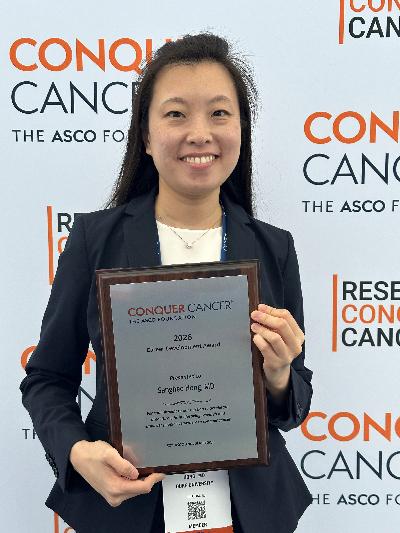
Sanghee Hong, MD, an assistant professor at Duke University School of Medicine, has received a career development award from the American Society of Clinical Oncology’s Conquer Cancer Foundation to advance research aimed at improving access to potentially curative cancer treatments.
Dr. Hong, a physician in Duke’s Adult Blood & Marrow Transplant and Leukemia programs, studies barriers that prevent patients with blood cancers from receiving advanced cellular therapies, including hematopoietic cell transplantation (HCT) and CAR-T therapy — treatments that can offer long-term remission or cure.
While these therapies have transformed outcomes for patients with relapsed or high-risk disease, access remains uneven.
Prior research led by Dr. Hong found that the vast majority of eligible patients are never referred for these treatments, with particularly low rates among Black patients, those in rural areas, and individuals from socioeconomically disadvantaged communities. Even among those referred, many never complete the evaluation or receive therapy.
“The largest barriers in access to cellular therapy occur at referral and before conversations about care,” Dr. Hong said. “If patients aren’t informed or supported early, they may never reach therapies that could save their lives.”
The work will examine the full referral pathway across North Carolina, identifying where and why patients fall out of the process. The study combines large-scale data analysis with patient interviews to uncover structural and communication barriers — such as travel distance, limited resources in community oncology settings, and delayed discussions about treatment goals.
A key innovation of the work is a community-focused virtual seminar program designed to support patients and families before referral. The seminars will provide accessible education about treatment options, help clarify care goals, and connect patients with supportive resources — particularly in underserved areas.
By partnering with community oncology practices and patient advocacy groups, the intervention aims to improve timely, informed referrals and ensure that more patients can access advanced therapies.
“By focusing on the earliest steps in the care journey, we can create scalable solutions that improve access not just at Duke, but nationwide,” Dr. Hong said.
The project is expected to generate a risk profile to guide future interventions and inform larger, multi-site studies. Ultimately, the research could shape national strategies to ensure equitable access to complex, resource-intensive cancer treatments.
Dr. Hong also serves as vice chief of Culture, Engagement, and Community in Duke’s Division of Hematologic Malignancies and Cellular Therapy and holds a joint appointment in the Department of Population Health Sciences.