
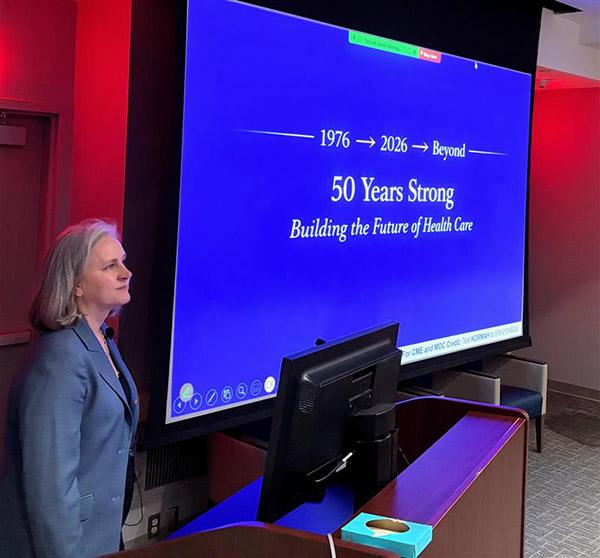
At February 20th’s Medicine Grand Rounds, faculty gathered to reflect on a milestone moment — 50 years of General Internal Medicine (GIM) — and to confront a challenge that will define the next 50: strengthening primary care in the United States.
GIM Chief Nicki Hastings opened with a simple but sobering truth: there is not enough access to primary care in the country.
While primary care physicians, family practitioners, geriatricians, pediatricians, and advanced practice providers form the backbone of the health system, they account for only about one-third of the physician workforce—far short of the roughly 50% many experts consider ideal.
Nearly 95 million Americans live in areas with inadequate access, and about 30% report having no usual source of care outside emergency settings.
The issue, she emphasized, is not only about workforce numbers. The needs of the population are intensifying. Americans are living longer, often with multiple chronic conditions, while behavioral health demands continue to rise.
Millions experience mental health or substance use disorders, frequently without treatment. Social challenges such as food insecurity, unstable housing, and limited income further complicate care delivery.
Primary care now sits squarely at the intersection of medical complexity and social reality.
Why Primary Care Matters
High-quality primary care is central to achieving what health systems strive for: better patient experience, improved population health, lower costs, clinician well-being, and health equity.
Decades of research show that communities with more primary care physicians experience lower mortality rates. Even modest increases in access can measurably extend life expectancy—an impact that underscores the field’s quiet but profound influence.
GIM is responding by redefining what primary care looks like in practice, education, and research. Rather than viewing care as a series of office visits, faculty are designing models that extend beyond clinic walls—into homes, communities, and digital environments.
One example is Quit at Duke, an innovative tobacco treatment program led by Dr. James Davis, associate professor. Now one of the largest smoking cessation programs in the country, it includes a multidisciplinary team serving more than 6,000 patients annually. The program delivers evidence-based care efficiently while tailoring interventions to high-risk populations, demonstrating a core principle of modern primary care: preventive services must be scalable, not simply layered onto already crowded physician visits.
Redesigning Care Teams
Another major focus is care team redesign. Faculty are studying how physicians, nurse practitioners, pharmacists, nurses, and care coordinators can work at the top of their training to manage both routine and urgent needs. As health care increasingly happens between visits—through messaging, remote monitoring, and virtual touchpoints—team-based care offers a more sustainable and responsive model.
Education is evolving alongside care delivery. Leadership tracks and advocacy programs prepare trainees to think beyond individual encounters and engage in health policy, population health, and system transformation. The goal is to train clinicians who are not only excellent caregivers, but also architects of better health systems.
Research efforts are also shifting toward “implementation science,” which examines how to move proven interventions into real-world practice faster. Too often, effective innovations take more than a decade to reach patients. By combining effectiveness and implementation research, GIM investigators aim to shorten that timeline and ensure discoveries translate into everyday care.
Collaboration is key to this mission, Hastings noted, pointing to the Duke Primary Care Research Consortium, which connects dozens of practices and hundreds of providers. The consortium enables frontline clinicians to help shape research questions and bring studies directly into community settings, serving as a living laboratory for improving care delivery.
Looking Ahead
Despite workforce shortages, uneven funding, and rising demand, the message was ultimately optimistic. The transformation underway is not simply about filling gaps, Hastings said, but about redesigning how care is organized, delivered, and experienced.
By aligning clinical innovation, education, and research around the realities of modern primary care, GIM is helping build a system that is more accessible, more equitable, and better prepared for the complex needs of the future.
There is much work to do — but also unprecedented opportunity to shape what comes next, Dr. Hastings concluded.