
At Duke University School of Medicine, mentorship is more than a professional norm — it’s encoded in the institution’s DNA.
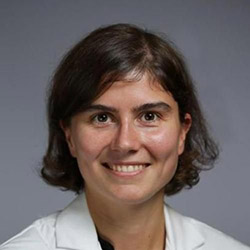
This ethos is being recognized nationally by the American Medical Women's Association (AMWA), which has selected health policy researcher and internist Dr. Caroline Sloan as a 2026 Exceptional Mentor, highlighting her dedication to advancing women in medicine through leadership and compassion.
“Mentorship is one of the most powerful forces for growth in medicine,” said Dr. Susan Hingle, AMWA Immediate Past President and Awards Chair. “These exceptional physician mentors have strengthened our community by modeling leadership, compassion, and encouragement.”
Those ideals are rooted in Dr. Sloan’s lived experience and have uniquely shaped her own approach to mentorship, but her path to becoming a mentor began long before she took on mentees of her own.
“Meta Mentor”
As a Harvard undergraduate research assistant at Massachusetts General Hospital, she worked with mentors who set an exemplary early standard for what that role could look like: accessible, invested — and deeply human.
“They saw potential in us and helped us work to the highest level of our abilities,” said Dr. Sloan, now an assistant professor and internist at Duke University Medical Center and Duke Outpatient Clinic in Durham. “They made time for us, they were present — and that stuck with me.”
The early exposure shaped how Dr. Sloan would later approach mentoring at Duke, where she arrived in 2015 for internal medicine residency.
Rather than emulating a single model, she built her style by assembling the best qualities she observed across many mentors — a strategy she likens to creating a “composite” of excellence or a “mentor network,” drawing on the expertise of clinicians, researchers, and policy leaders.
Among her most influential were Drs. Virginia Wang and Matt Maciejewski from the Department of Population Health Sciences, physician and behavioral scientist Dr. Peter Ubel, clinician-educator Daniella Zipkin, and David Edelman, Director of the Duke Clinical and Translational Science Awards program.
Each brought something different — methodological rigor, clinical judgment, and career guidance — together forming what Dr. Sloan calls a “meta mentor.”
“No one person can give you everything you need,” she said. “You have to find the people who are really good at different kinds of advice and have different areas of expertise and put that together.”
Now a mentor herself, Dr. Sloan applies these lessons with mindful intention. One of the most important, she believes, is consistency. During her fellowship, regular standing meetings with Dr. Wang — weekly at first — provided both structure and a real sense of investment.
“It showed me what it means to really support someone,” said Sloan, who emphasizes depth over volume, limiting the number of mentees she takes on to ensure meaningful engagement. “Not just when there’s a problem, but all the time. “You have to have time for your mentees. Otherwise, it’s not real mentorship.”
Equally important is fostering independence. Sloan encourages trainees to pursue their own ideas — even when they diverge from her own research.
“If you want to be a good mentor, you have to let people follow their interests,” she said. “That’s how they grow.”
Duke: A Culture of Connection
At Duke, mentorship is reinforced by a collaborative environment and built-in opportunities — from student research programs to interdisciplinary initiatives such as Bass Connections.
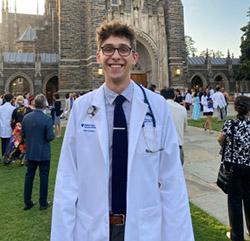
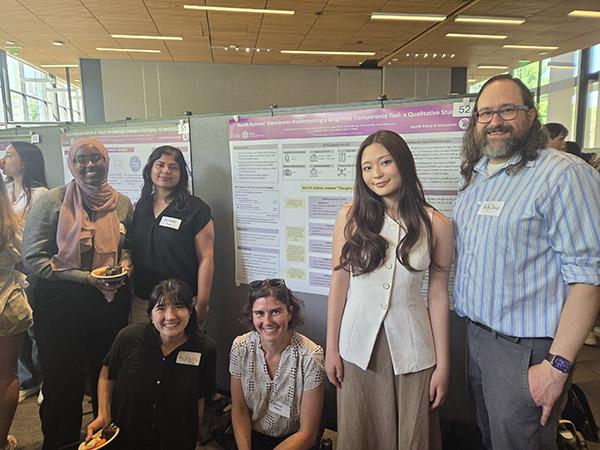
Dr. Sloan has served as a mentor for Seth Kornbau (MD ’27) through completion of his third-year medical student project, a qualitative study that examines the experiences of health systems from around the country in choosing whether to adopt and implement a medication price estimator tool embedded in electronic health records.
Kornbau’s Duke Bass Connections project team also includes five undergraduate students and two additional medical students, creating an opportunity for Dr. Sloan to mentor Kornbau in how to mentor others, which has been great for confidence building in planning and executing meeting agendas and educational sessions for the undergraduates, he said.
She has also taken an interest in other areas of his professional development, including learning how to develop an effective research presentation with plans to present their work at several upcoming national conferences, abstract and research paper writing, topics in health policy and healthcare regulation, and general career and residency application advice as needed.
What has been most valuable about having Dr. Sloan as a mentor, he added, is that she goes above and beyond what is necessary to ensure that she is providing enough availability and access to her mentees.
“I feel like I’m a true mentee and not just another student working on research,” Kornbau said. “Medical students stand to gain a lot from having a supportive and accessible mentor that they can trust, and I am grateful for having had the opportunity to learn research and leadership skills from Dr. Sloan. The lessons I’ve learned from her are things I will carry forward through my career as a physician for decades to come.”
“It’s easy to co-mentor across departments here,” she said, describing learning alongside colleagues while precepting and turning everyday patient care into opportunities for shared growth. “There’s a collegiality that makes it work. “In medicine, there’s always uncertainty. Having people you trust to talk things through with — that’s invaluable.”
Lifting Each Other Up
Sloan’s reach extends beyond Duke to national peer-mentoring networks. Through programs like the Society of General Internal Medicine’s LEAHP Program and the Health and Aging Policy Fellowship, she has built relationships with colleagues across the country — connections she once hesitated to call “networking.”
“I used to think I didn’t like networking,” she said. “But really, it’s just building genuine relationships. It’s about lifting each other up.”
Among the many lessons Sloan has absorbed, one stands out: pursue what excites you. She recalls pivotal advice from Dr. Ubel during her training — keep going as long as the work remains meaningful and fun.
“There’s no reason to stay on a path you don’t enjoy,” she said. “We have too many opportunities in medicine.”
For Sloan, mentorship is about helping others find — and follow — that path. Her recognition as an Exceptional Mentor reflects not only her own efforts but the many mentors who shaped her along the way.
“I wouldn’t be here without them,” she said. “This is really a reflection of everything they gave me.”
Now, through her work at Duke and beyond, Dr. Sloan is lifting up her mentees — and doing her part to keep Duke’s medical mentorship legacy strong.