

2023-2024 SEEDS Scholarly Projects Announced
A highlight of the SEEDS program each year is the projects that are selected for publication or presentation. The Department of Medicine is proud to announce our 2023-2024 project winners, Drs. Willard Applefeld, Ann Cameron Barr, Dan Loriaux, Emily Sanders, Ilia Shadrin, and Rachel V. White. These projects offer innovative measures that will further strengthen our curriculum.

Moving Medicine Forward: Dr. Shariff Receives Community Cancer Centers Innovators Award
Afreen Shariff, MD, assistant professor in the division of Endocrinology, Metabolism and Nutrition, has been selected by the Association of Community Cancer Centers (ACCC) as a 2023 Innovator Award recipient for her work on the effectiveness of electronic consults for immune-related endocrine toxicities.

Transformational Leader Quinn Capers, MD, to Deliver June 16 Greenfield Lecture
Academic medicine transformation leader Quinn Capers, IV, MD, the Rody P. Cox Professor of Internal Medicine (Cardiology) and associate dean for faculty at the University of Texas Southwest School of Medicine, will deliver the June 16 Greenfield lecture.
The event will be held in person only beginning at 8 a.m. in Duke North, 2002. Breakfast will be served outside of the room starting at 7:45am.

Announcing the 2023 DOM Administrative Award Winners
The Department of Medicine is delighted to announce the winners of our 2023 Administrative Awards. Please join us in thanking them for their hard work and for demonstrating Duke's values.

Gagliardi Promoted to Associate Dean for Learning Environment and Well-Being
Jane Gagliardi, MD, MHS, has been promoted to associate dean for Learning Environment and Well-being in the School of Medicine.

GIM Division Update with Interim Chief Dr. William Yancy
By William Yancy, MD
Interim Chief, Division of General Internal Medicine
The Division of General Internal Medicine at Duke strives to improve adult patient, family, community, and population health through exemplary patient care, education, and research. Perhaps most importantly, we have maintained core values of excellence, integrity, kindness, and commitment to health and health equity for our patients and our communities.

2023 Resident Research Day Features Califf Research Award Winners
The Department of Medicine’s 2023 Resident Research Day, held Friday, May 19, featured presentations from this year’s Califf Research Award winners followed by a poster presentation with 18 entrants.
Q&A Spotlight: Distinguished Professors Christopher Granger and Rana Gupta
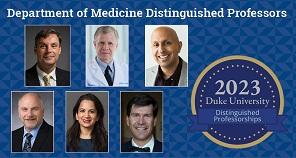
Duke University has awarded Distinguished Professorships to 44 faculty members, six from the Department of Medicine. Over the coming weeks, join us in recognizing these Distinguished Professors through our Distinguished Professor Spotlight. This week, we feature Christopher Granger, MD, and Rana Gupta, PhD.

Dr. Wilder Leads Three-Year Study to Improve Health Literacy in Underserved Communities
Dr. Julius Wilder will lead a three-year investigational health equity patient education study to examine how diverse populations respond to various patient-education tactics such as print, digital, and video, with the goal of identifying the most effective methods and communication infrastructures for communicating relevant and important health information to diverse communities.
Berg, Joshi, and McDonald to Receive 2023 DOM Master Clinician Awards
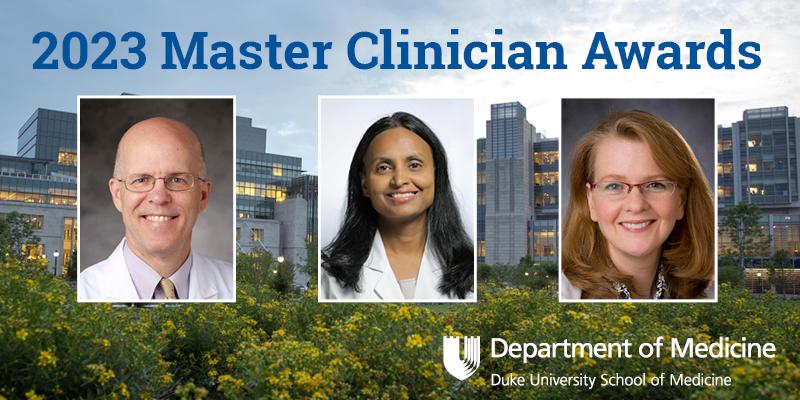
The Department of Medicine (DOM) is pleased to announce the recipients of the annual Master Clinician Award, Carl Berg, MD, Sangeeta Joshi, MD, MBBS, and Shelley McDonald, DO, PhD.